Issue 01
November 2026
06Friday
6 November
Day 01

Il Mare

Polignano a MareMonopoli
CoverPolignano a Mare

Land, collect the car and head straight for the sea. Lunch on the cliffs of Polignano, a walk round Monopoli's harbour as the afternoon softens, then inland to the masseria for dinner.

Meteo

3 places
Polignano a Mare
Monopoli
Santo Scalone
Live forecasts appear here once the guide is published online. Until then, tap a town.
01

Programme

  1. 12:00
    Arrive Bari airport
  2. 13:00
    Collect the rental car
    About 35 min to Polignano on the SS16
  3. 14:00
    Lunch in Polignano a Mare
    Then down to Lama Monachile
  4. 16:00
    Monopoli
    Harbour, walls and castle, with focaccia at La Barese
  5. 18:00
    Drive to Masseria Santo Scalone
    Short drive inland
  6. 20:00
    Dinner at Santo Scalone
    Booked
02

Places

3 features
Polignano a Mare
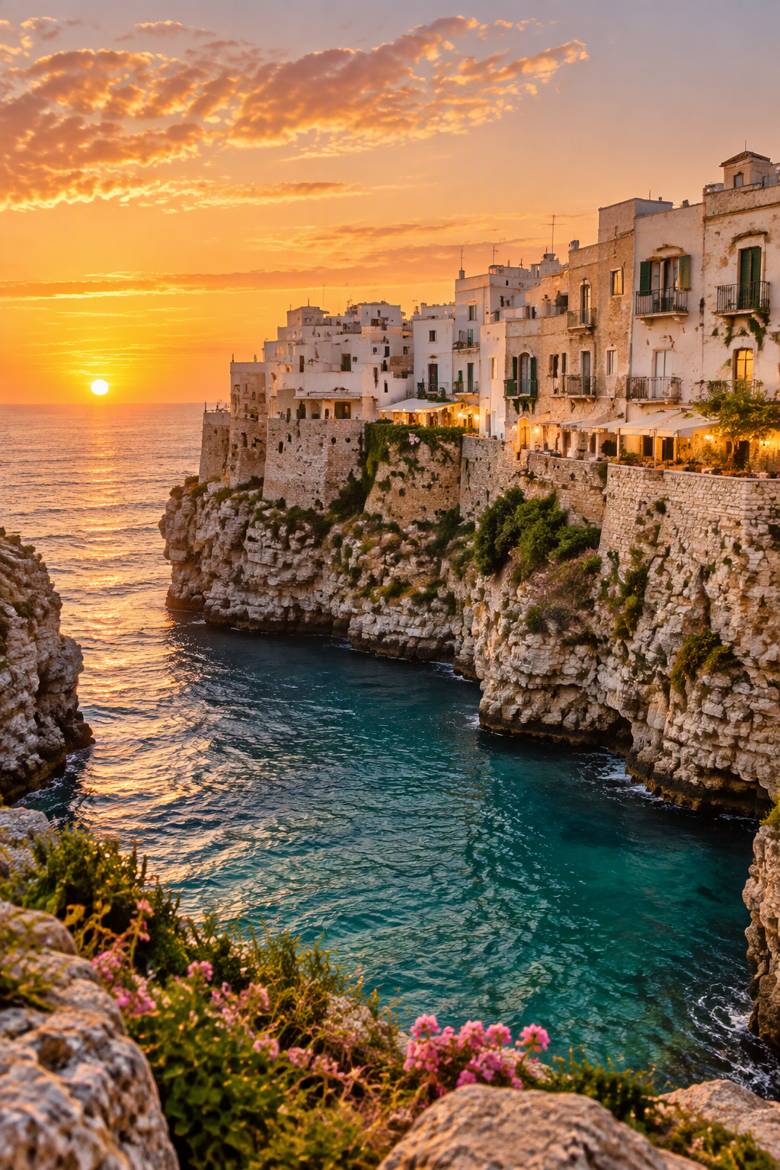
Fig. 01Polignano a Mare
Province of Bari · Adriatic coast

Polignano a Mare

Setting
Limestone cliffs, 20 m above the sea
Known for
Lama Monachile cove
From Bari
35 min by car

A town built on the edge of a cliff. The old town sits on a limestone spur that has been hollowed out by the sea, so on calm days you can hear the water moving in the caves under the streets.

People have lived here since prehistory. The Greeks traded along this coast, and the Romans ran the Via Traiana through the area on its way to Brindisi. Today's old town is small and walled. You enter through the Arco Marchesale, the only gate. Inside, the lanes are whitewashed and short, and almost every one ends at a balcony over the Adriatic.

Many of the walls have short poems painted on doors and steps. They're by a local street poet who signs himself Guido the Poet. Look for his white lettering as you walk.

In November the town is quiet and local again. The light is lower and golden, and the sea often looks clearest after a wind.

Da vedere
  1. 01
    Lama MonachileThe little pebble cove squeezed between two cliffs, crossed by the arches of a Bourbon-era bridge on the old Via Traiana. See it from the bridge, then walk down the steps to the shore.
  2. 02
    Arco MarchesaleThe old town's only gate, once closed every night. It's the natural way in from Piazza Garibaldi.
  3. 03
    The terracesBalconies such as Terrazza Santo Stefano look straight down the cliff face. Hold the boys' hands. The railings are fine, but the drops are real.
  4. 04
    Statue of Domenico ModugnoThe singer of “Nel blu dipinto di blu” (“Volare”), born here in 1928. He stands on the seafront with his arms flung wide. Ideal for a photo.
  5. 05
    Grotta PalazzeseA famous cave restaurant cut into the cliff below the hotel of the same name. Glimpse it from the sea-level viewpoints.
Da assaggiare
Crudo di mare
Raw local seafood: prawns, sea urchin when in season, and mussels
Caffè speciale
A local coffee with lemon zest, sugar, cream and a dash of Amaretto. Created in Polignano and served in a small glass
Practical
  • The old town is a limited-traffic zone (ZTL). Park outside it, along the seafront or in the paid car parks off Via Pompeo Sarnelli, and walk in.
  • The cliff paths have uneven stone and few barriers, so it's buggy-unfriendly but fine on foot.
Monopoli
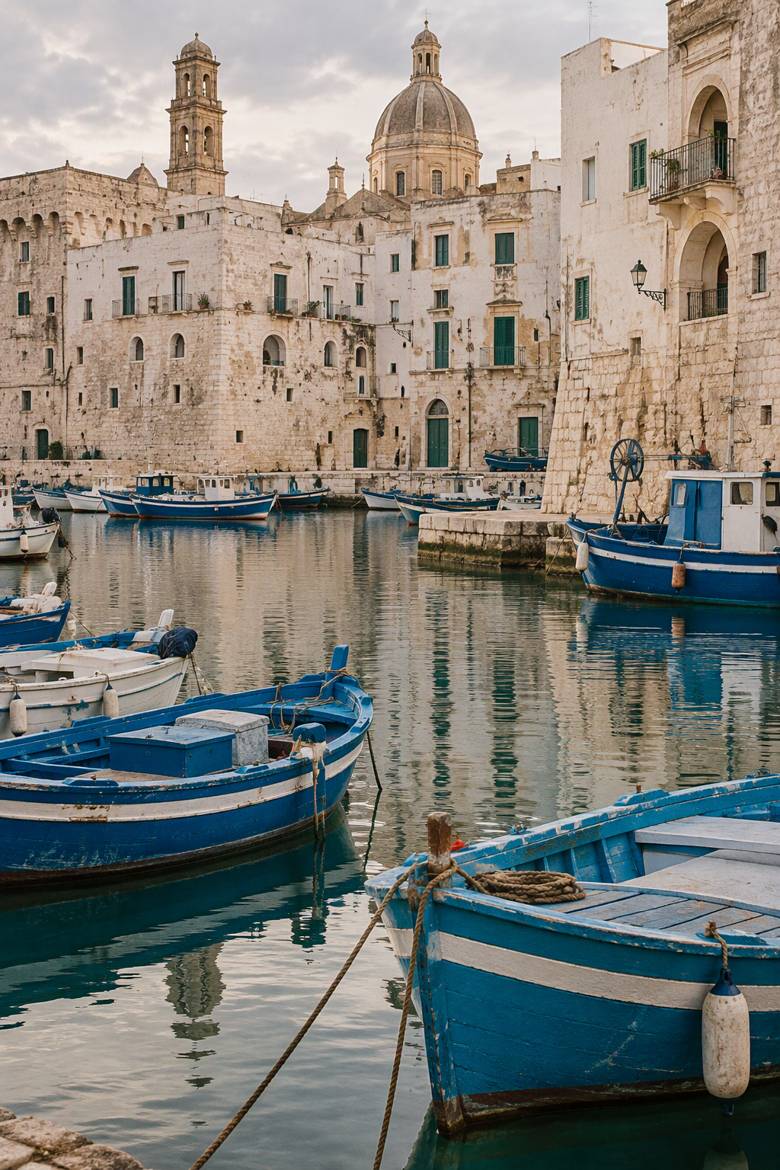
Fig. 02Monopoli
Province of Bari · Adriatic coast

Monopoli

Name
From the Greek monos polis, “the single city”
Known for
Blue fishing boats, sea walls
From Polignano
15 min

A real working port town rather than a postcard. Monopoli's old town curls round a small harbour full of blue wooden gozzi (fishing boats). It's guarded by a castle and a long run of sea walls you can walk along.

Monopoli grew rich on sea trade in the Middle Ages and kept its fortifications into the 1500s. The castle was rebuilt under Emperor Charles V, so it's known locally as the Castello Carlo V. It sits on the point where the walls meet the sea.

The town's patron is the Madonna della Madia. Legend says that in 1117 her icon arrived floating on a raft of beams (madia) at just the moment the builders of the cathedral had run out of timber for the roof. The beams went into the roof and the icon into the church. Monopoli still celebrates her arrival.

Around the town are more than 100 rural churches and masserie. Many of the farms that produce the area's oil are a few kilometres inland, where Santo Scalone is.

Da vedere
  1. 01
    Porto AnticoThe old harbour. Boats are painted blue, white and red, and fishermen mend nets on the quay in the mornings.
  2. 02
    Castello Carlo VA pentagonal castle on the headland, with a walk along the walls beside it.
  3. 03
    Cattedrale della Madonna della MadiaA baroque cathedral with a rich interior and a crypt revealing Roman and earlier layers.
  4. 04
    Cala Porta VecchiaA small beach tucked under the town walls. It's a good spot for a sunset.
  5. 05
    Largo VescovadoA pretty square in the old town, with cafés for an afternoon espresso and a juice for the boys.
Da assaggiare
Focaccia barese
Soft and oily, topped with tomatoes and olives. Try it at La Barese
Polpo
Octopus, often grilled or braised. A local fisherman's staple
Practical
  • Park in the large car parks around Via Magenta or the port, outside the old town ZTL.
  • It's an easy, flat walk from the harbour to the castle, so even the four-year-old will manage.
The Masseria
Fig. 03The Masseria
Countryside between Monopoli and Fasano

The Masseria

What
Fortified farmhouse
Era
Mostly 16th–18th century
Purpose
Farming, oil, defence

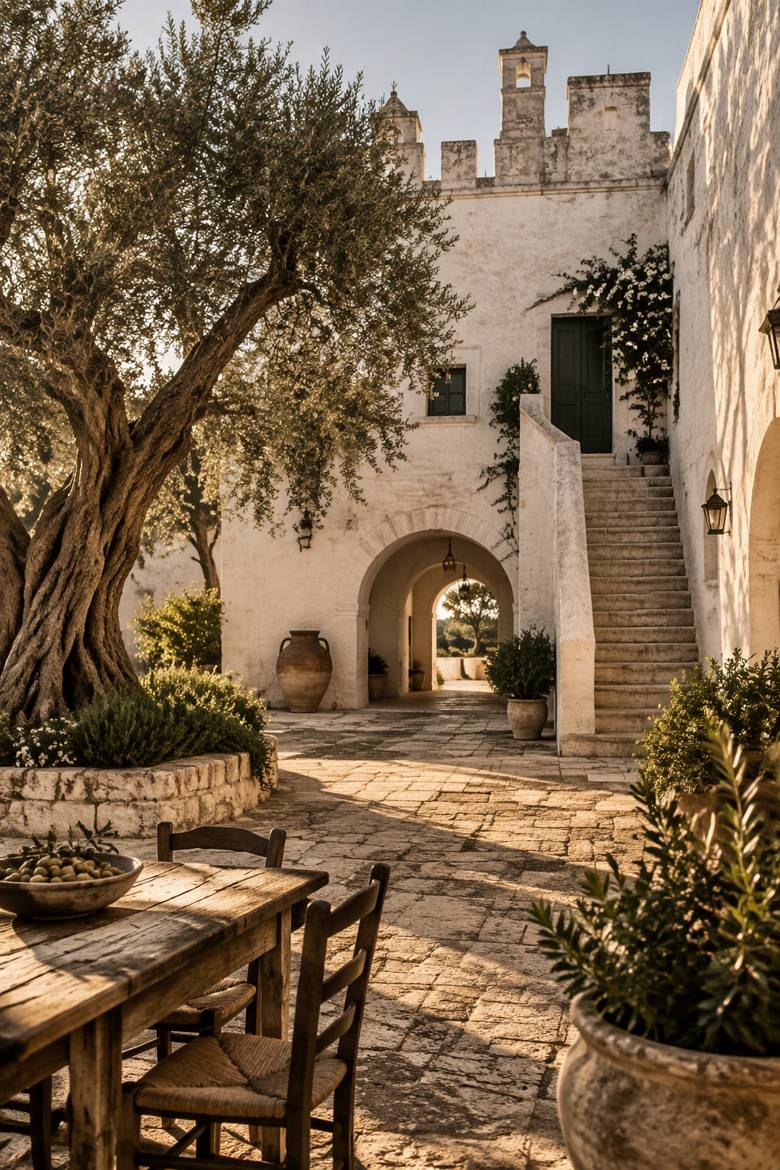
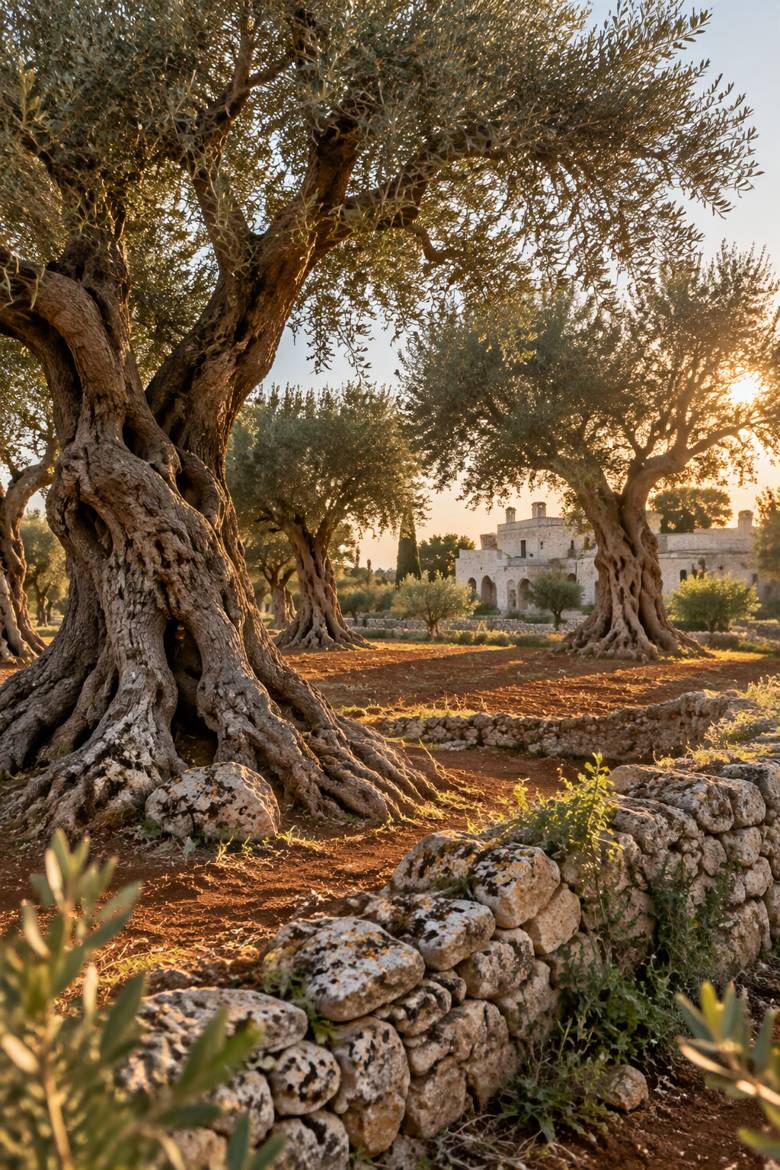
Masserie are the great farmhouses of Puglia. They're self-contained estates with thick white walls, towers and courtyards, built to run an agricultural world and to keep it safe.

From the 1500s the coast was often raided by Ottoman and Barbary pirates. Landowners built their farms like small fortresses. They had a defensive tower, few windows at ground level and, in some, machicolations for dropping things on attackers. Inside were the owner's house, workers' rooms, stables, a chapel and storerooms. There was often an underground mill (frantoio ipogeo) carved into the rock to press olives at a steady temperature.

Many masserie fell empty in the 20th century, as farming changed. Over the past 30 years many have been restored as hotels and restaurants, and the best ones still farm their land. Santo Scalone is a working olive estate, which is why your tour comes with the harvest in full swing.

The landscape around you is the Piana degli Ulivi Secolari, the “plain of the centuries-old olive trees”. Some of the trees between Monopoli, Fasano and Ostuni are well over a thousand years old, with trunks twisted into extraordinary shapes.

Da vedere
  1. 01
    The courtyard (aia)This open yard was once used for threshing grain. Today it's where the house's life happens.
  2. 02
    The towerLook for the defensive tower and its narrow slit windows.
  3. 03
    The grovesWalk the dry-stone walls (muretti a secco) between the trees. UNESCO lists the craft of building them as intangible heritage.
Da assaggiare
Olio nuovo
Brand-new oil, only weeks old in November. It's green, grassy and peppery, and it should catch at the back of your throat. That's the polyphenols, a sign of quality
Bruschetta con olio nuovo
Toast, garlic, salt and new oil. The simplest and best way to taste it
Practical
  • Ask on the farm tour which cultivars they grow. In this area expect Ogliarola, Coratina and Cima di Mola.
  • The country lanes are narrow and walled, so drive slowly after dark.
03

A Tavola

Where to eat
  1. Lunch

    Infermento

    Polignano · historic centre

    Informal and welcoming, with a short local menu, a few creative touches and a strong wine list. Relaxed enough for the boys.

    via Gambero RossoDirections →
  2. Lunch · alternative

    L'Osteria di Chichibio

    Polignano

    A long-standing name for fish, now under new management, with elegant cooking. More polished, so it's best if the boys are settled.

    via Gambero RossoDirections →
  3. Gelato

    Gusto Caruso

    Via Martiri di Dogali 3, Polignano

    Made in-house from fresh organic milk. Try the fiordilatte and pistachio.

    via Gambero RossoDirections →
  4. Focaccia

    La Barese

    Monopoli

    Very light, airy focaccia barese from a young baker from a Bari baking family. Get the classic tomato version.

    via Gambero RossoDirections →
Issue 01 · 6–9 November 2026
Weather: Open-Meteo · Photography generated with Microsoft Copilot
07Saturday
7 November
Day 02

La Città Bianca

OstuniThe olive harvestIl Frantoio
CoverOstuni

A slow masseria breakfast, then up to Ostuni, the white city, while the light is clear. Back for the olive harvest on the estate, and finish with dinner at Il Frantoio.

Meteo

2 places
Santo Scalone
Live forecasts appear here once the guide is published online. Until then, tap a town.
01

Programme

  1. 09:00
    Breakfast at Santo Scalone
  2. 10:30
    Ostuni
    Park below, then climb to the cathedral and walk the outer walls
  3. 13:00
    Lunch in Ostuni
    See below
  4. 15:30
    Olive farm tour at Santo Scalone
    Harvest season, so taste the olio nuovo
  5. 20:00
    Dinner at Masseria Il Frantoio
    Booked
02

Places

2 features
Ostuni
Fig. 04Ostuni
Province of Brindisi · “La Città Bianca”

Ostuni

Elevation
About 220 m
Cathedral
Late Gothic, finished 1495
From the masseria
25 min

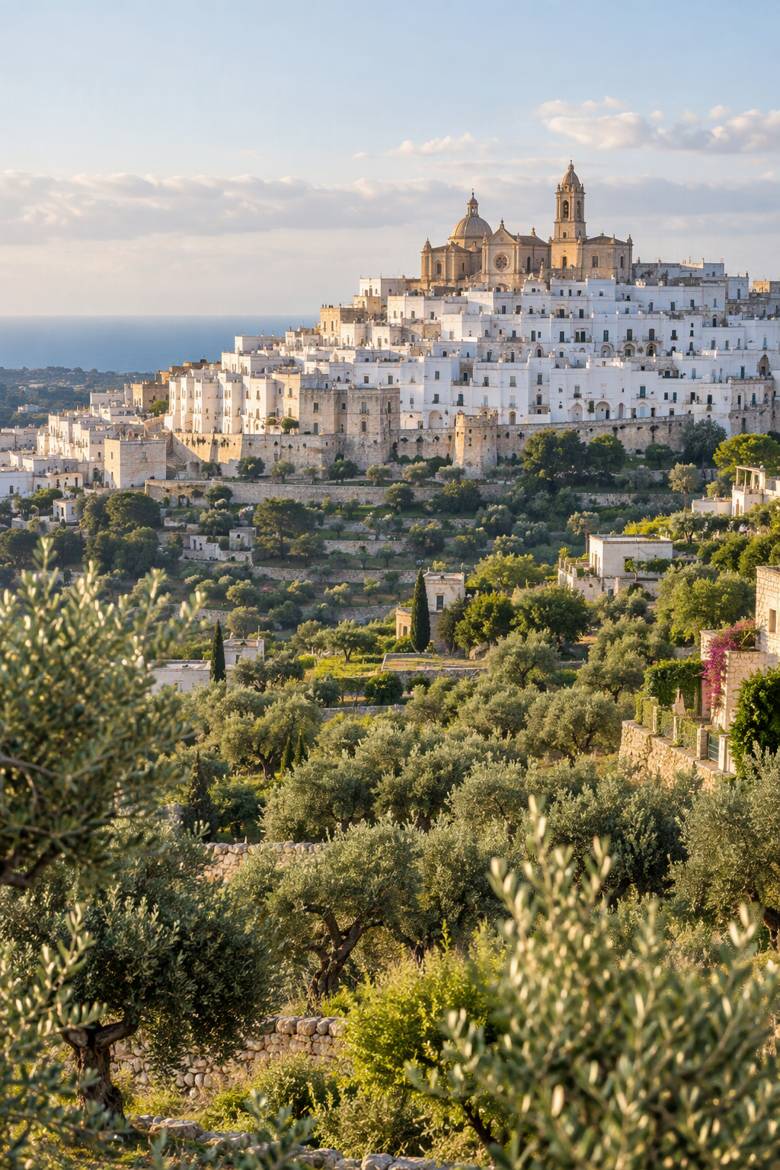
Ostuni rises from the olive plain like a stack of sugar cubes. The old town is whitewashed with lime, wraps round a hilltop and looks out to the Adriatic about 8 km away.

The hill has been lived on for a very long time. In a cave nearby, archaeologists found the 28,000-year-old skeleton of a young woman who died while pregnant. Known as Delia, she's now in the town's Museo di Civiltà Preclassiche.

The whitewash is practical as much as pretty. Lime was cheap and local, and it reflected the summer heat and lit the dark alleys. It was also used as a disinfectant, notably during plague outbreaks in the 1600s. People still renew it every year.

At the top stands the cathedral, built in the late 1400s. Its facade combines a Gothic shape with one of the most beautiful rose windows in southern Italy. Just below is Piazza della Libertà, the town's living room, with its tall baroque column to Sant'Oronzo, the patron saint who is credited with saving the town from plague.

Da vedere
  1. 01
    Concattedrale di Santa Maria AssuntaLate Gothic facade with a large rose window. Look for Christ at the centre, surrounded by the apostles.
  2. 02
    Piazza della LibertàThe main square and the Guglia di Sant'Oronzo column, about 21 m tall.
  3. 03
    Larghetto & Via CattedraleThe steep, stepped lanes between the square and the cathedral are the most atmospheric part of town.
  4. 04
    Porta San Demetrio & the wallsA walk round the outside of the old walls on Viale Oronzo Quaranta gives the best views over the olive plain to the sea.
  5. 05
    Museo di Civiltà PreclassicheHome of “Delia”. It's small, so check its opening times before you go.
Da assaggiare
Capocollo di Martina Franca
Cured pork neck smoked over oak and almond shells, from just up the road
Orecchiette alle cime di rapa
The region's signature pasta with bitter turnip-top greens, at their best in November
Practical
  • The historic centre is a ZTL. Use the car parks below the old town, on Corso Mazzini and near Viale Pinto.
  • Wear comfortable shoes. Ostuni is steps everywhere, and the stone can be slippery after rain.
  • Many shops and restaurants close from about 13:30 to 16:30 out of season.
The Masseria
Fig. 05The Masseria
Countryside between Monopoli and Fasano

The Masseria

What
Fortified farmhouse
Era
Mostly 16th–18th century
Purpose
Farming, oil, defence

Masserie are the great farmhouses of Puglia. They're self-contained estates with thick white walls, towers and courtyards, built to run an agricultural world and to keep it safe.

From the 1500s the coast was often raided by Ottoman and Barbary pirates. Landowners built their farms like small fortresses. They had a defensive tower, few windows at ground level and, in some, machicolations for dropping things on attackers. Inside were the owner's house, workers' rooms, stables, a chapel and storerooms. There was often an underground mill (frantoio ipogeo) carved into the rock to press olives at a steady temperature.

Many masserie fell empty in the 20th century, as farming changed. Over the past 30 years many have been restored as hotels and restaurants, and the best ones still farm their land. Santo Scalone is a working olive estate, which is why your tour comes with the harvest in full swing.

The landscape around you is the Piana degli Ulivi Secolari, the “plain of the centuries-old olive trees”. Some of the trees between Monopoli, Fasano and Ostuni are well over a thousand years old, with trunks twisted into extraordinary shapes.

Da vedere
  1. 01
    The courtyard (aia)This open yard was once used for threshing grain. Today it's where the house's life happens.
  2. 02
    The towerLook for the defensive tower and its narrow slit windows.
  3. 03
    The grovesWalk the dry-stone walls (muretti a secco) between the trees. UNESCO lists the craft of building them as intangible heritage.
Da assaggiare
Olio nuovo
Brand-new oil, only weeks old in November. It's green, grassy and peppery, and it should catch at the back of your throat. That's the polyphenols, a sign of quality
Bruschetta con olio nuovo
Toast, garlic, salt and new oil. The simplest and best way to taste it
Practical
  • Ask on the farm tour which cultivars they grow. In this area expect Ogliarola, Coratina and Cima di Mola.
  • The country lanes are narrow and walled, so drive slowly after dark.
03

A Tavola

Where to eat
  1. Lunch

    Osteria del Tempo Perso

    Ostuni · centro storico

    Traditional Puglian cooking in a vaulted, characterful space, with a relaxed lunchtime feel.

    via Roam & Thrive (Ostuni-based writer)Directions →
  2. Lunch · alternative

    Osteria Ricanatti

    Corso Cavour, Ostuni

    A local writer's favourite, where the food is the main event. Expect handmade pasta and excellent grilled meats.

    via Roam & Thrive (Ostuni-based writer)Directions →

Out of season, many places in Ostuni close or cut their hours. Phone before you drive up.

Issue 01 · 6–9 November 2026
Weather: Open-Meteo · Photography generated with Microsoft Copilot
08Sunday
8 November
Day 03

Pietra & Barocco

Matera if dryLecce if wet
CoverMatera if dry

Two great stone cities, two very different days. Matera is outdoors, on steep stone steps, so save it for a dry day. Lecce is flat, compact and full of interiors, so it's the perfect rainy-day plan.

Meteo

2 places
Live forecasts appear here once the guide is published online. Until then, tap a town.
—

Matera or Lecce?

Your call
The verdict

Matera if the forecast is dry, Lecce if rain is likely. Check the weather above, then choose.

About 1 h 20 from the masseria
01

Programme

  1. 09:30
    Leave the masseria
  2. 11:00
    Belvedere Guerricchio
    The great view over the Sasso Caveoso
  3. 11:30
    Casa Grotta & Santa Maria de Idris
    Cave home, then the rock church
  4. 13:00
    Lunch
    See below
  5. 15:00
    Duomo, then Sasso Barisano
    Wander down the lanes
  6. 16:30
    Drive back
02

Places

1 feature
Matera
Fig. 06Matera
Basilicata · UNESCO World Heritage

Matera

UNESCO
Since 1993
Capital of Culture
2019
From the masseria
About 1 h 20

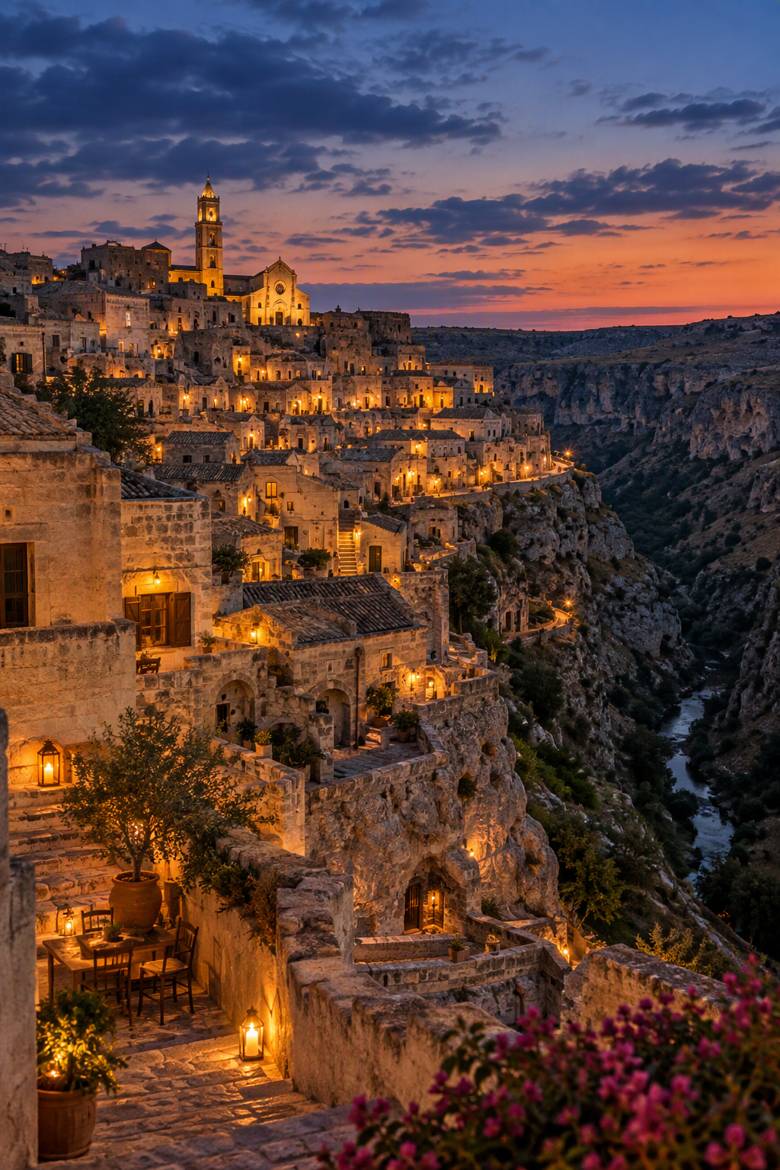
Matera is one of the oldest continuously inhabited places on earth. It's a city of cave houses, rock churches and stairways carved into a deep ravine called the Gravina.

People have lived in the caves of the Murgia plateau since the Palaeolithic. Over the centuries the caves were extended with facades, terraces and vaults, until two whole districts filled the slopes: the Sasso Barisano (facing Bari, to the north-west) and the Sasso Caveoso (facing south). Water was collected with remarkable care in channels and huge cisterns. The Palombaro Lungo under the main square is like an underground cathedral of water.

By the mid-20th century, many families were living in the caves in great poverty, with their animals. The writer Carlo Levi called it a national disgrace. In the 1950s the Italian government moved about 15,000 people into new housing on the plateau, and the Sassi stood almost empty for decades.

Recognition began in 1993, when the Sassi became a UNESCO World Heritage Site. Matera was then European Capital of Culture in 2019. Today the caves are hotels, restaurants and homes again. Film-makers love the place: The Passion of the Christ and No Time to Die were both shot here.

Da vedere
  1. 01
    Belvedere Luigi GuerricchioThe classic view across the whole of the Sasso Caveoso. Start here.
  2. 02
    Cathedral & Piazza DuomoA 13th-century Apulian Romanesque cathedral on the ridge between the two Sassi.
  3. 03
    Casa Grotta di Vico SolitarioA furnished cave home showing exactly how a family lived in the 1950s, with their mule and hens inside. It's brilliant for the boys.
  4. 04
    Palombaro LungoThe vast underground cistern below Piazza Vittorio Veneto. Tours are guided and short.
  5. 05
    Santa Maria de IdrisA church cut into a rock outcrop in the Sasso Caveoso, with frescoes inside.
  6. 06
    Belvedere di Murgia Timone (from across the ravine)The view back at the city from the far side. Only go if you have time and the ground is dry.
Da assaggiare
Pane di Matera
A huge, golden durum-wheat loaf with protected status (IGP). Each family used to mark its own
Peperoni cruschi
Sweet red peppers, dried and flash-fried until crisp. Crumble them over pasta
Cialledda
A peasant dish of stale bread, tomato and onion
Practical
  • Park on the plateau (try around Via Saragat or Piazza della Visitazione) and walk down. You can't drive in the Sassi.
  • There are lots of steps and they can be slippery when wet. That's why Matera is the dry-day plan.
  • Lunch places in the Sassi fill up on Sunday, so book.
03

A Tavola

Where to eat
  1. Lunch

    Stano

    Via Santa Cesarea 67, Sasso Barisano

    Family-run with all the Matera classics, from cialledda to cavatelli with crusco peppers, plus wood-fired pizza for the boys.

    via Gambero RossoDirections →
  2. Lunch · alternative

    Trattoria Lucana

    Via Lucana 48

    Rustic cooking built on local produce, including orecchiette with crusco peppers. Informal and welcoming, but expect a short queue.

    via Gambero RossoDirections →

It's Sunday, so book lunch. Some trattorie don't open for Sunday lunch out of season.

About 1 h 15 from the masseria
01

Programme

  1. 09:30
    Leave the masseria
  2. 10:45
    Porta Napoli → Piazza del Duomo
    Enter the closed square
  3. 11:45
    Basilica di Santa Croce
    Before it closes for lunch
  4. 13:00
    Lunch
    See below
  5. 15:00
    Piazza Sant'Oronzo
    Amphitheatre and a warm pasticciotto
  6. 16:00
    Cartapesta workshop
    Then drive back
02

Places

1 feature
Lecce
Fig. 07Lecce
Salento · “The Florence of the South”

Lecce

Stone
Pietra leccese, a soft limestone
Style
Barocco leccese, 17th century
From the masseria
About 1 h 15

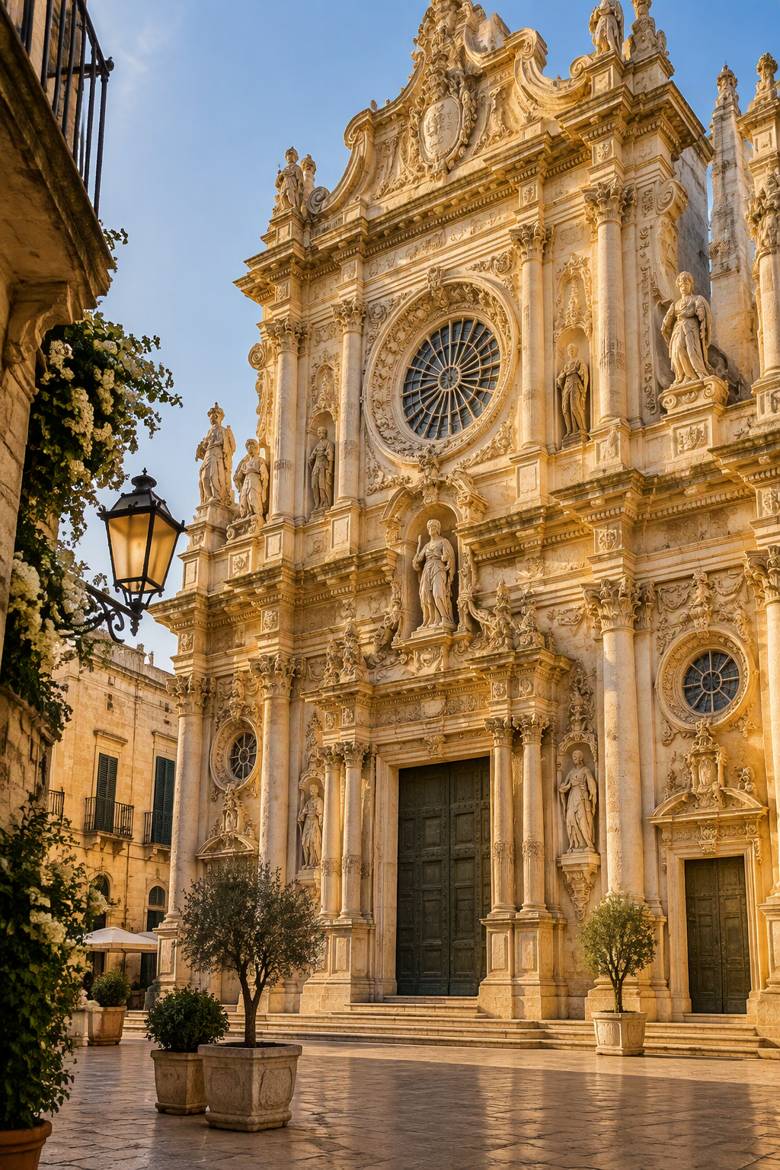
An entire city carved from honey-coloured stone. Lecce's baroque is lavish, cheerful and almost edible, with fruit, cherubs, dragons and saints frothing over every facade.

Lecce was Roman Lupiae, and its amphitheatre still lies half-excavated in the main square. The city's golden age came in the 1600s under Spanish rule. Religious orders and noble families poured money into churches and palazzi, and a group of local architects developed a style entirely their own, led by Giuseppe Zimbalo and Giuseppe Cino.

That style was only possible because of the stone. Pietra leccese is soft and fine-grained when it's quarried, so it can be carved almost like wood, and it hardens and turns golden with exposure to the air. It's also why Lecce glows at sunset.

Lecce is also known for cartapesta (papier-mâché). Since the 1700s local artisans have made life-size saints and nativity figures from paper, straw and glue. Several workshops in the centre welcome visitors. It makes a lovely, light souvenir.

Da vedere
  1. 01
    Basilica di Santa CroceThe masterpiece. Its facade took more than a century to finish. Look for the animals and grotesque figures holding up the balcony.
  2. 02
    Piazza del DuomoA closed square entered through one opening, with the cathedral, bishop's palace and a 70 m bell tower. It's dramatic, especially in late light.
  3. 03
    Piazza Sant'OronzoThe heart of town, with the Roman amphitheatre and the column of the patron saint.
  4. 04
    Porta NapoliA triumphal arch built in 1548 in honour of Charles V.
  5. 05
    Teatro Romano & MUSTA smaller Roman theatre, and the city museum in a former monastery. They're good options if it rains.
Da assaggiare
Pasticciotto
A shortcrust pastry filled with custard, best eaten warm in the morning. Lecce's signature
Rustico leccese
Puff pastry filled with béchamel, mozzarella and tomato. The perfect snack for the boys
Caffè leccese
Iced espresso with almond milk, a local habit even in winter
Practical
  • The centre is a ZTL with cameras. Park outside, for example near Porta Napoli or the castle, and walk. It's all flat, which makes Lecce good in the rain.
  • Most churches close around midday. See Santa Croce and the Duomo before lunch.
03

A Tavola

Where to eat
  1. Lunch

    Alle Due Corti

    Corte dei Giugni 1

    Old-school Lecce, with a menu partly in dialect. Try ciceri e tria or fave e cicorie. Warm and lively, so very family-friendly.

    via Scatti di Gusto · Roam & ThriveDirections →
  2. Lunch · alternative

    Arte dei Sapori

    Vico degli Alami 3

    Traditional recipes with a modern touch, under star vaults in the baroque centre.

    via Scatti di GustoDirections →
  3. Pastry

    Pasticciotto

    Any good pasticceria

    Custard-filled shortcrust, eaten warm. Essential.

    via Local classicDirections →

It's Sunday, so book lunch. Some trattorie don't open for Sunday lunch out of season.

Issue 01 · 6–9 November 2026
Weather: Open-Meteo · Photography generated with Microsoft Copilot
09Monday
9 November
Day 04

Trulli & Partenza

AlberobelloLocorotondoBari
CoverAlberobello

A fairy-tale morning among the trulli, then Locorotondo's circular white town above the vineyards. Drop the car in central Bari for a final walk and dinner in the old town, then take a taxi to the airport.

Meteo

3 places
Alberobello
Locorotondo
Live forecasts appear here once the guide is published online. Until then, tap a town.
01

Programme

  1. 10:00
    Alberobello
    Rione Monti, Belvedere Santa Lucia, Trullo Sovrano
  2. 12:30
    Lunch
    See below. Many places close on Mondays
  3. 14:30
    Locorotondo
    The lungomare walk round the edge of town
  4. 16:30
    Drive to Bari & return the car
    About 1 h. Allow for city traffic
  5. 17:30
    Bari Vecchia
    San Nicola, Arco Basso, the castle
  6. 19:30
    Dinner
    First sitting. Mention the flight
  7. 20:30
    Taxi to the airport
    20–30 min
  8. 21:45
    Flight
02

Places

3 features
Alberobello
Fig. 08Alberobello
Valle d'Itria · UNESCO World Heritage

Alberobello

UNESCO
Since 1996
Trulli
About 1,500 in town
From the masseria
25 min

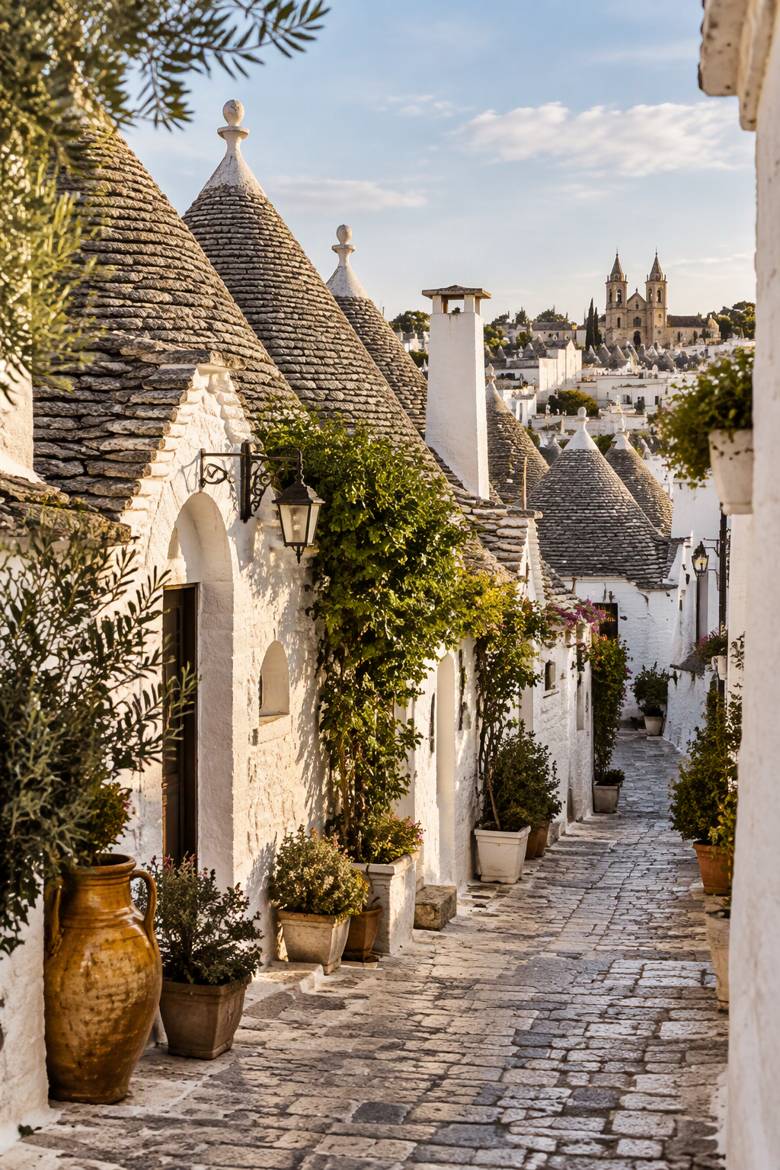
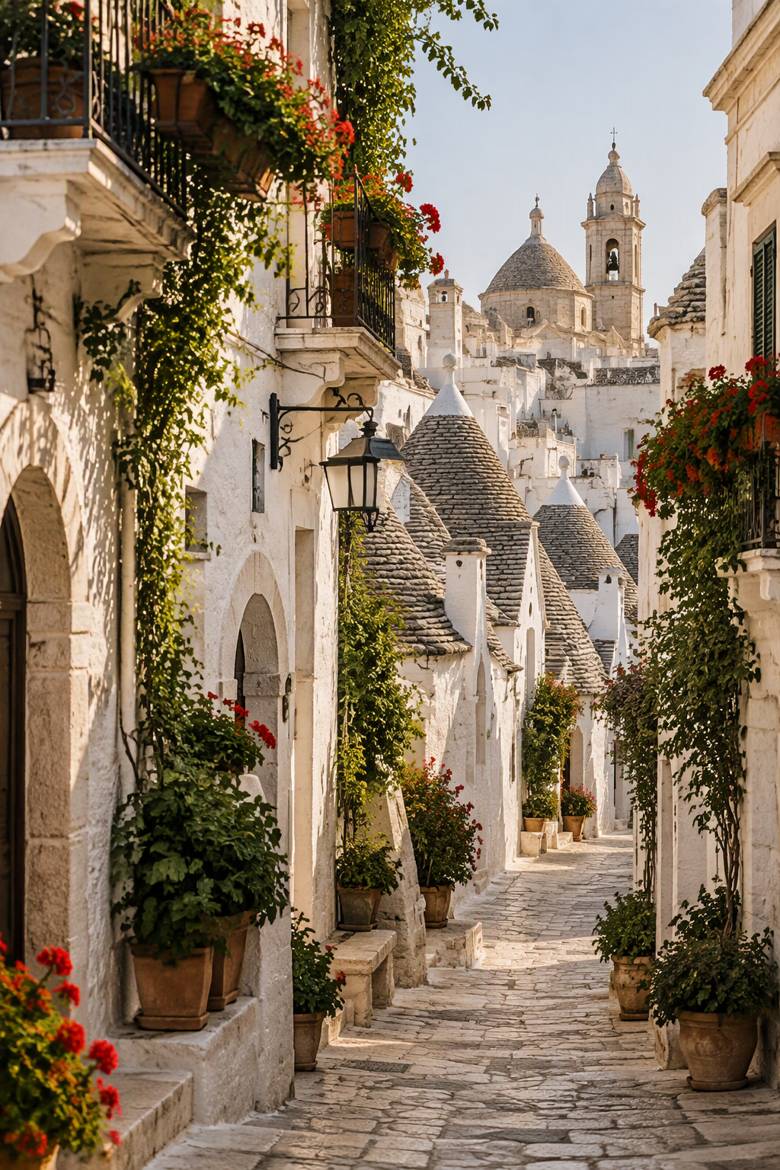
A town of fairy-tale stone houses with conical roofs: the trulli. They're built entirely without mortar, and whitewashed so they shine against the grey stone.

Trulli are an ancient building technique of the Murgia. They're made from limestone dug from the fields and stacked dry in a false dome, with a thick wall below. The roof is finished with a decorative pinnacle (pinnacolo), which is said to have identified the builder or brought good luck.

The story everyone tells is about tax. In the 1600s the Counts of Conversano are said to have ordered peasants to build without mortar. The houses could then be dismantled quickly when royal inspectors came, so they wouldn't count as permanent buildings. Whether or not it's true, Alberobello received royal recognition as a town in 1797, and today the trulli are a UNESCO site.

There are two trulli districts. Rione Monti is the larger and busier, with over 1,000 trulli climbing the hill, many of them now shops. Aia Piccola is quieter and residential, with about 400 trulli, and it's where you'll see more ordinary life.

Da vedere
  1. 01
    Rione MontiStart at the bottom, then climb Via Monte San Michele to the trullo-shaped church of Sant'Antonio.
  2. 02
    Aia PiccolaQuieter lanes across the main road, for a more authentic feel.
  3. 03
    Trullo SovranoThe only two-storey trullo in town, built in the 18th century and now a small house museum.
  4. 04
    Belvedere Santa LuciaThe postcard view down over the roofs of Rione Monti.
  5. 05
    Trullo SiameseTwo trulli joined together. Locals tell a story of two brothers and a quarrel over a girl.
Da assaggiare
Bombette
Rolls of pork filled with cheese, grilled in a butcher's oven. A Valle d'Itria institution
Primitivo di Gioia del Colle
A full red from just north
Practical
  • Park in one of the paid car parks off Via Indipendenza or Largo Martellotta.
  • Many trulli “shops” invite you up to their roof terraces for a view. It's free, but buying something small is appreciated.
  • Lots of restaurants close on Monday. Have a plan B (see the lunch picks).
Locorotondo
Fig. 09Locorotondo
Valle d'Itria · I Borghi più belli d'Italia

Locorotondo

Name
“Round place”
Wine
Locorotondo DOC white
From Alberobello
10 min

A perfectly round hilltop town above the Valle d'Itria. Its lanes spiral inward in rings, and the views fall away over a patchwork of vineyards, dry-stone walls and scattered trulli.

From the valley floor you can see why it's called the round place. The medieval centre forms a near-perfect circle on top of the hill. Inside, the streets are spotless, whitewashed and full of flowers, with wrought-iron balconies and carved doorways.

Look up at the roofs. The town's typical houses are the cummerse, with steep pitched roofs made of stone slabs called chiancarelle. They're a cousin of the trulli, but a gabled rather than conical form, and found almost only here.

The surrounding countryside is wine country. The local white, Locorotondo DOC, is made mostly from Verdeca and Bianco d'Alessano grapes. It's fresh and light, and very good with the region's seafood.

Da vedere
  1. 01
    Lungomare (Via Nardelli)Called the seafront even though there's no sea. This is the panoramic walk round the edge of town, looking over the valley like an ocean of green.
  2. 02
    Chiesa Madre di San GiorgioA big neoclassical church with a dome.
  3. 03
    Chiesa di San NicolaA tiny church with a lovely painted interior.
  4. 04
    The ringsJust get lost in the concentric lanes. You can't go far wrong.
Da assaggiare
Locorotondo DOC
Fresh local white wine
Gnummareddi
Lamb offal skewers grilled on the fornello, for the brave
Practical
  • Park on the ring road outside the centre, for example near Villa Comunale Garibaldi.
  • The town is small. An hour is plenty, with a coffee.
Bari Vecchia
Fig. 10Bari Vecchia
Capital of Puglia

Bari Vecchia

Patron
San Nicola (Saint Nicholas)
Relics arrived
1087
To the airport
About 20–30 min by taxi

The old town of Puglia's capital is a dense maze on a peninsula. It's loud and friendly, with washing overhead, nonnas making pasta at their doors and churches around every corner.

Bari's great moment came in 1087. A group of Bari sailors took the relics of Saint Nicholas from Myra, in what is now Turkey, and brought them home. The Basilica di San Nicola was built to house them, and it became one of the major pilgrimage sites of the Middle Ages. It's still important to both Catholics and the Orthodox world. Saint Nicholas is, of course, the saint behind Santa Claus.

For decades Bari Vecchia had a rough reputation. Since the 1990s it has been restored and is now one of the most enjoyable old towns in the south. It's safe, alive and very local.

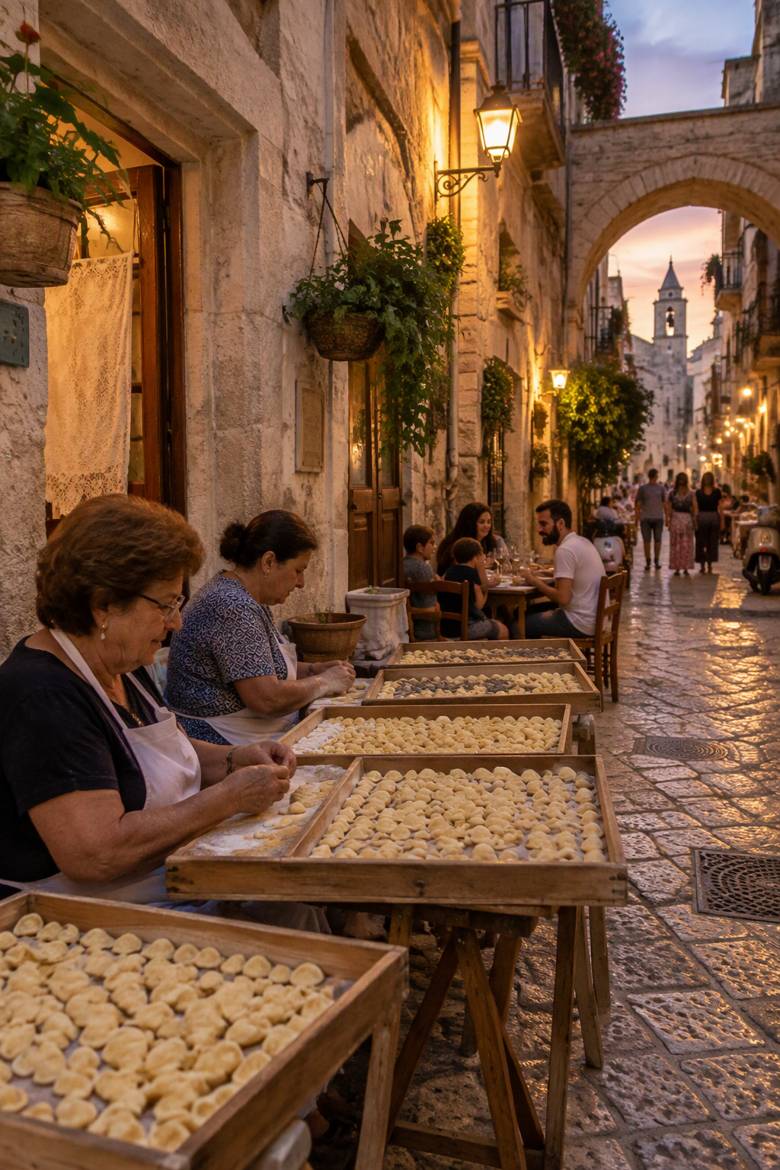
Strada Arco Basso and the lanes around it are famous for the women who make orecchiette by hand at tables outside their homes, then dry them on wooden screens. You can watch, and often buy a bag to take home.

Da vedere
  1. 01
    Basilica di San NicolaApulian Romanesque at its finest. The saint's tomb is in the crypt.
  2. 02
    Cattedrale di San SabinoA quieter Romanesque cathedral with a lovely rose window.
  3. 03
    Castello Normanno-SvevoA Norman–Swabian castle rebuilt by Frederick II, on the edge of the old town.
  4. 04
    Strada Arco BassoThe orecchiette ladies. It's best in the late morning, but there's often someone still there in the afternoon.
  5. 05
    Piazza Mercantile & Piazza FerrareseLively squares at the old town's edge, perfect for a pre-dinner walk.
  6. 06
    LungomareA grand seafront promenade heading south from the old town.
Da assaggiare
Orecchiette
“Little ears”, best with cime di rapa or ragù
Tiella barese
Rice, potatoes and mussels, baked together
Sgagliozze & popizze
Fried polenta squares and fried dough balls. Street food in paper cones
Panzerotti
Fried half-moons filled with tomato and mozzarella
Practical
  • Return the car first, then explore on foot. The old town is mostly pedestrian.
  • Take a taxi from Corso Vittorio Emanuele or ask the restaurant to call one. Allow 20–30 min to the airport and be there by about 20:45.
03

A Tavola

Where to eat
  1. Lunch · Alberobello

    Evo Ristorante

    Via Papa Giovanni XXIII 1

    Modern cooking rooted in the area, with veg from their own garden, an all-pasta menu and seats in trulli. Check they're open on Monday.

    via Gambero RossoDirections →
  2. Lunch · Locorotondo

    Anima Ristorante

    Corso XX Settembre 126

    Stone cross-vaults and well-judged modern dishes. Its listing shows Monday as dinner only, so phone first.

    via Gambero RossoDirections →
  3. Dinner · Bari

    La Cecchina

    Piazza Mercantile 31

    Barese tradition with a light touch, under stone barrel vaults on the old town's main square. About €35 a head.

    via Gambero RossoDirections →
  4. Dinner · alternative

    Antò Cucina e Sapori Tipici

    Strada Palazzo di Città 14

    Family-run, simple and generous, near San Nicola. They do orecchiette, meatballs, and patate riso e cozze.

    via Gambero RossoDirections →
  5. Focaccia

    Panificio Fiore

    Strada Palazzo di Città 38

    A century-old bakery in a former church, with a wood-fired oven. Legendary focaccia.

    via Gambero RossoDirections →
  6. Gelato

    Gentile

    Piazza Federico II di Svevia 33

    Silky gelato and granita, by the castle.

    via Gambero RossoDirections →

Many Valle d'Itria restaurants close on Monday. Fallback: focaccia and panzerotti on the go, then a proper dinner in Bari.

Issue 01 · 6–9 November 2026
Weather: Open-Meteo · Photography generated with Microsoft Copilot
*The essentials
Puglia

La Guida

RegionOlive oilFoodArchitecturePractical
CoverA Tavola

Everything that doesn't belong to a single day: how the region fits together, what you're eating, how to read the buildings, and the small rules that make Italy run smoothly.

01

The Region

Fig. 11The Region

The heel of the boot

Puglia runs almost 400 km along the Adriatic and Ionian seas, making it the longest coastline of any region on the Italian mainland. It's mostly flat or gently rolling limestone. That stone is everywhere: in the dry-stone walls, the trulli, the masserie and the cathedrals.

You're staying in the region's most beautiful corner. The coast runs from Polignano to Ostuni, and just inland is the Valle d'Itria, a high, green basin of vineyards, oak woods and trulli between Alberobello, Locorotondo, Cisternino and Martina Franca.

Puglia has been a crossroads for 3,000 years. Greek, Roman, Byzantine, Norman, Swabian, Angevin, Aragonese, Spanish and Bourbon rulers have all left their marks. The great Romanesque cathedrals of the coast, such as Bari, Trani and Bitonto, date from the 11th–13th centuries, when the ports were busy with pilgrims and crusaders.

02

Olive Oil

Fig. 12Olive Oil

Green gold

Puglia has an estimated 60 million olive trees and produces around 40% of Italy's olive oil. The harvest runs from October to December, so you've arrived at its heart. Nets are spread under the trees, branches are shaken or combed, and the olives go to the mill within hours.

Great oil is about speed and temperature. Cold extraction keeps the aroma and the polyphenols, which give the bitterness and the peppery catch in your throat. These are signs of quality, not faults. Olio nuovo, only days or weeks old, is at its most vivid now.

There's a sad backdrop. Since 2013 a bacterium, Xylella fastidiosa, has killed millions of trees further south in Salento. You'll see grey, dead groves if you drive towards Lecce. The ancient trees around Ostuni and Fasano are being closely protected.

03

A Tavola

Fig. 13A Tavola

What to order

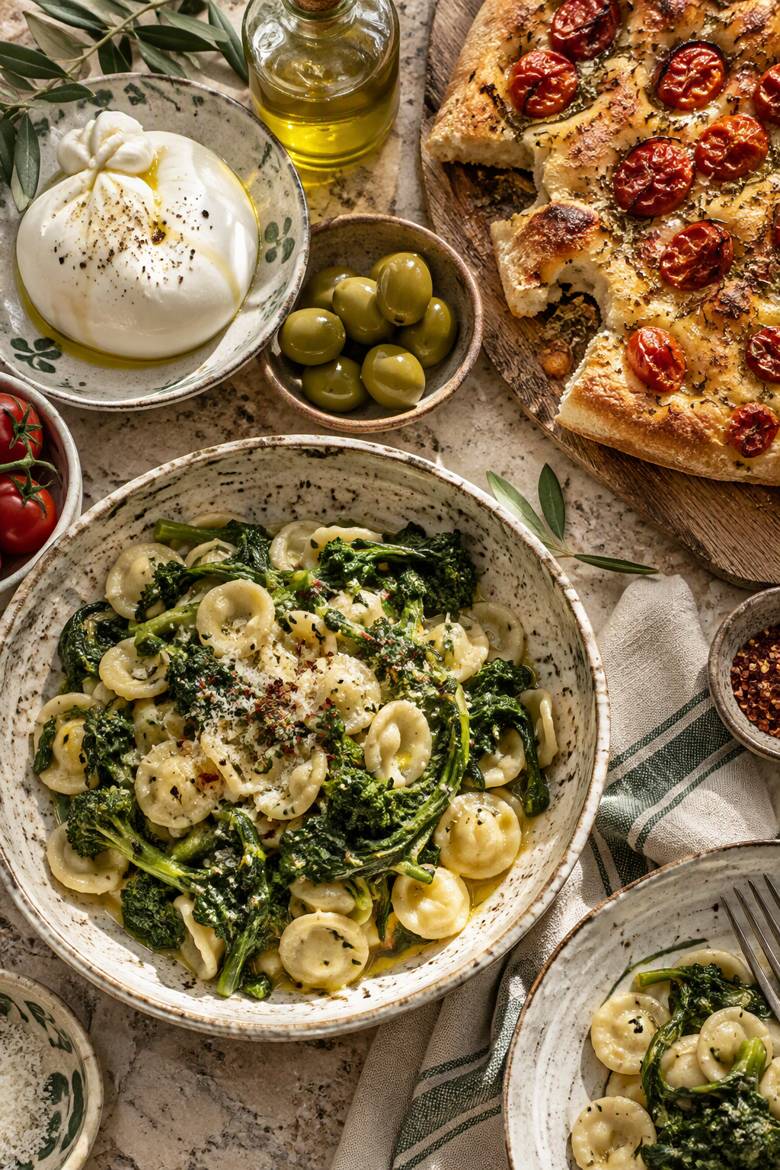
Orecchiette con cime di rapa
“Little ears” with bitter turnip-top greens, anchovy, garlic and chilli. The regional dish, in season now
Fave e cicoria
Dried broad-bean purée with wild chicory and lots of oil. Peasant food at its best
Burrata & stracciatella
Burrata comes from Andria: mozzarella with a heart of cream and shredded curd (stracciatella)
Focaccia barese
Soft and oily, with cherry tomatoes and olives, sometimes potato in the dough
Panzerotto
A fried half-moon of dough filled with tomato and mozzarella. Children's favourite
Bombette
Pork rolls stuffed with cheese, from the butcher-grills of the Valle d'Itria
Capocollo di Martina Franca
Cured pork neck, lightly smoked
Crudo di mare
Raw seafood. November is the start of the ricci (sea urchin) season
Tiella barese
Baked rice, potatoes and mussels
Taralli
Crunchy ring crackers, often with fennel seed. The perfect car snack
Pasticciotto
Lecce's warm custard tart
Wines
Primitivo and Negroamaro (red), Nero di Troia, Locorotondo and Verdeca (white), and Salento rosato
04

Architecture

Fig. 14Architecture

Reading the stone

Trulli are dry-stone houses with corbelled conical roofs. They're mostly found in and around the Valle d'Itria and are rarely more than a couple of centuries old in their current form, though the technique is ancient.

Masserie are fortified farm estates, built largely from the 1500s to the 1700s. Look for towers, few ground-floor windows and enclosed courtyards.

Apulian Romanesque is the cathedral style of the 11th–13th centuries, with pale stone, tall naves, rose windows and carved portals. Bari's San Nicola is the model. Leccese baroque is the 17th-century explosion of carving in soft golden stone, found in Lecce. Whitewash, used in Ostuni, Locorotondo and Cisternino, is lime renewed every year, a mix of hygiene and heat management.

05

Practical

Good to know
ZTL zones
Nearly every historic centre is a Zona a Traffico Limitato, with cameras. Never drive past the ZTL sign. Fines are sent to the rental company and then to you, months later. Park outside and walk in.
Parking colours
Blue lines mean paid parking (pay at the machine or with the EasyPark app). White lines are free. Yellow lines are reserved.
Riposo
Shops and churches close roughly 13:00–16:30. Restaurants serve lunch from about 12:30 to 14:30 and dinner from about 19:30 or 20:00.
At the table
Coperto is a small cover charge per person and is normal. Tipping isn't expected. Rounding up or leaving a few euros for good service is kind.
Coffee
Order at the counter (al banco), where it's cheaper. Cappuccino is a morning drink.
Emergency
112 for everything. Pharmacies have a green cross, and one is always on duty at night (farmacia di turno).
Phrases
Buongiorno / Buonasera (from about 17:00). Per favore, grazie. Il conto, per favore (the bill). Un tavolo per quattro (a table for four). Due bambini (two children).